 中文简体
中文简体
 English
 Español
 عربى
عربى
Velvet, velveteen, and velour are three distinct pile fabrics that look similar on the surface but differ fundamentally in fiber content, construction method, and practical performance. Velvet is a woven fabric traditionally made from silk or synthetic filament yarns, producing a dense, upright pile with a lustrous sheen and smooth hand feel. Velveteen is a cotton-based woven fabric cut to create a shorter, matte pile that is more durable and washable than velvet. Velour is a knitted fabric, typically made from cotton or polyester, with a looped or cut pile that stretches in all directions, making it the most comfortable and flexible of the three. If you need to choose between them for a sewing project, upholstery, or a garment purchase, the short answer is: use velvet for formal wear and decorative applications, velveteen for structured garments and children's clothing, and velour for activewear, loungewear, and stretch applications. This article covers each fabric in depth, compares them directly, and provides practical guidance for every major use case.
Content
- 1 Velvet Fabric Characteristics: What Defines Velvet
- 2 Velvet vs Velveteen: The Key Differences
- 3 Velveteen vs Velour: Construction and Performance Compared
- 4 Velour vs Velvet: Why They Belong to Different Categories
- 5 Side-by-Side Comparison of All Three Fabrics
- 6 Choosing the Right Fabric by Application
- 7 Care and Maintenance for Each Fabric Type
- 8 Sewing Tips Specific to Each Pile Fabric
Velvet Fabric Characteristics: What Defines Velvet
Velvet is defined by its manufacturing method rather than by any single fiber. It is produced on a special loom that weaves two layers of fabric simultaneously, with pile yarns connecting the two layers. The double cloth is then cut apart in the middle, creating two pieces of fabric each with an upright pile on one face. This process is called double weaving or face-to-face weaving, and it is what gives velvet its characteristically dense, even pile that stands perpendicular to the base cloth.
Pile Height and Density
The pile height of velvet typically ranges from 1.5 mm to 4 mm, with most apparel-weight velvets falling between 1.5 and 2.5 mm and furnishing velvets running slightly deeper at 2.5 to 4 mm. Pile density, meaning the number of pile yarn ends per square centimeter, is the primary determinant of how luxurious the fabric feels. High-quality silk velvet has a pile density of approximately 120 to 180 pile ends per square centimeter, which creates the characteristic soft crush and light-catching depth that has made velvet a luxury material for centuries. Lower-density synthetic velvets, while visually similar, feel noticeably lighter and less substantial when handled.
Fiber Types Used in Velvet Production
Historically, velvet was made exclusively from silk, which remains the finest and most expensive option. Modern velvet is produced from a range of fibers, each with distinct characteristics:
- Silk velvet: The original and most prestigious form. Extremely soft, with a luminous sheen that changes dramatically with light angle and pile direction. Costs significantly more than synthetic alternatives, typically 40 to 120 pounds or dollars per meter for quality silk velvet, and requires dry cleaning.
- Viscose or rayon velvet: The most widely used velvet in fashion applications. Viscose pile on a woven backing produces a sheen and drape close to silk at a fraction of the cost. It is softer and more fluid than polyester velvet but also more prone to crushing and watermarking.
- Polyester velvet: The most affordable and widely available velvet. More resilient than viscose, holds its pile better under wear, and is easier to care for. The sheen is brighter and less nuanced than silk or viscose, giving it a more obviously synthetic appearance at close range.
- Cotton velvet: Less common than viscose or polyester. Has a matte, soft pile without the sheen of filament fiber velvets. More breathable than synthetic options and holds dye well, producing rich, deep colors. Heavier than most synthetic velvets.
The Nap Direction and Its Practical Consequences
One of the most practically important velvet fabric characteristics is its directional pile, called the nap. When pile fibers lean consistently in one direction, running your hand one way produces a smooth, glossy surface; running it the other way produces a rougher, deeper-colored appearance. This directionality has significant consequences for cutting and sewing: all pattern pieces must be cut in the same nap direction, otherwise adjacent panels will appear to be two different colors when the garment is assembled. This requirement effectively increases fabric consumption by 15 to 30% compared to a non-directional fabric of the same width and makes velvet more expensive to produce as a garment.
Velvet vs Velveteen: The Key Differences
Velveteen is often described as a cotton version of velvet, and while that framing is broadly helpful, it obscures a more fundamental difference: velveteen and velvet are made by completely different weaving methods, and the difference in construction explains why their properties diverge so significantly despite their similar appearance.
How Velveteen Is Made
Velveteen is woven as a single cloth, not as a double cloth like velvet. Extra weft yarns are woven into the base fabric in a floating arrangement, and these floats are then cut and brushed upright to form the pile. This is called a weft-pile construction. Because the pile yarns run across the width of the fabric (weft direction) rather than being continuous vertical filaments, the pile in velveteen is shorter and less uniform at the microscopic level than in velvet. Velveteen pile height typically ranges from 1 to 2 mm, slightly shorter on average than apparel velvet, and the pile has a distinctly more matte, less lustrous appearance because cotton fibers scatter light rather than reflecting it in the directional way silk or viscose filaments do.
Where Velveteen Outperforms Velvet
The cotton weft-pile construction of velveteen gives it several practical advantages over velvet that make it the preferred choice in many applications:
- Washability: Most velveteen can be machine washed on a gentle cycle, making it significantly more practical for childrenswear, workwear, and everyday garments than velvet, which typically requires dry cleaning or very careful hand washing.
- Durability: The weft-pile construction of velveteen is more resistant to pile crushing and wear than the cut pile of velvet. Velveteen upholstery fabrics can withstand 25,000 to 40,000 Martindale rub cycles before showing significant pile wear, compared to 15,000 to 25,000 for most velvet upholstery grades.
- Body and structure: Velveteen has more inherent stiffness than velvet, which makes it easier to cut, sew, and press into tailored shapes. It holds its form in structured garments such as blazers, trousers, and skirts without requiring as much interfacing as velvet, which tends to be fluid and drapy.
- Cost: Cotton velveteen is typically less expensive per meter than viscose or silk velvet of comparable weight, making it accessible for projects where budget is a consideration.
Where Velvet Outperforms Velveteen
Velvet's woven filament pile produces qualities that velveteen cannot replicate regardless of quality level. The luminous sheen of silk or viscose velvet, the way its color appears to shift from deep to light as you move around it, and the extraordinarily soft, fluid drape of high-grade velvet are all direct results of its filament pile construction and are inherently beyond what a cotton weft-pile fabric can produce. For formal eveningwear, theatrical costumes, and high-end home furnishings where visual impact and tactile luxury are the primary requirements, velvet remains the superior choice.
Velveteen vs Velour: Construction and Performance Compared
Velveteen and velour share a cotton heritage and a similar matte pile surface, which leads to frequent confusion between them. However, they differ in one critical structural dimension: velveteen is a woven fabric and velour is a knitted fabric. This single difference produces a cascade of practical distinctions that affect how each fabric behaves in cutting, sewing, wearing, and washing.
Stretch: The Defining Difference
Because velour is knitted, its loop structure gives it stretch in two or all directions depending on the knit construction used. A standard cotton velour typically stretches 50 to 80% in the crosswise direction and has moderate recovery. Velveteen, being woven, has negligible stretch in either direction. This makes them suited to fundamentally different applications: velour for body-conforming garments where movement and flexibility are required, velveteen for structured garments where the fabric must hold a shape without distorting under tension.
Pile Character and Surface Appearance
Velour is produced by knitting a base fabric with loops that are then either left intact (loop pile velour) or cut (cut pile velour). Cut pile velour has a surface resembling velveteen, while loop pile velour has a slightly more textured, terry-like surface. Both forms have a softer, more compressible pile than velveteen because the knitted base allows the pile to deflect more easily when pressure is applied. This softness is a functional advantage in garments worn against the skin but a disadvantage in upholstery, where velour's pile tends to flatten under sustained pressure from seated occupants more quickly than velveteen.
Sewing and Handling Differences
From a construction perspective, velour and velveteen require different sewing approaches. Velour's stretch means that seams must be sewn with a stretch stitch or overlocker to prevent thread breakage when the garment is worn. Standard lockstitch seams will pop when the fabric stretches. Velveteen, by contrast, behaves much more like a standard woven fabric in construction and can be sewn with a standard lockstitch, though a walking foot is recommended to prevent the pile layers from shifting during stitching.
Velour vs Velvet: Why They Belong to Different Categories
Velour and velvet are both cut-pile fabrics with a soft surface, and in certain colors and weights they can look deceptively similar in photographs. In practice, however, they belong to entirely different fabric categories and are not interchangeable in any application.
Velvet is a woven fabric with a rigid, non-stretch structure. Its pile is formed from continuous filament yarns that produce a distinctly smooth, glossy surface. Velour is a knitted fabric with inherent stretch and a softer, more compressed pile surface. The key practical differences are:
- Drape and structure: Velvet drapes in long, fluid folds ideal for formal gowns and curtains. Velour clings and stretches to the body, making it unsuitable for structured or draped applications.
- Sheen: Velvet has a characteristic light-catching sheen, particularly in silk and viscose versions, that is a central part of its appeal. Velour has a consistently matte or semi-matte surface that does not exhibit the same directional light play.
- Care: Many cotton and polyester velours are fully machine washable and tumble dryable at low heat, making them far more practical for everyday wear than velvet, which typically requires dry cleaning or delicate hand washing.
- Price: Velour, particularly polyester velour used in sportswear and lounge sets, is among the most affordable pile fabrics available, with retail fabric prices commonly between 3 and 10 pounds or dollars per meter. Quality velvet ranges from 15 to 120 pounds or dollars per meter depending on fiber content and weight.
Side-by-Side Comparison of All Three Fabrics
The table below summarizes the most practically important differences between velvet, velveteen, and velour across the dimensions that matter most for purchasing, sewing, and care decisions.
| Property | Velvet | Velveteen | Velour |
|---|---|---|---|
| Fabric Structure | Woven (double cloth) | Woven (single weft-pile) | Knitted |
| Typical Fiber | Silk, viscose, polyester | Cotton | Cotton or polyester |
| Pile Height | 1.5 to 4 mm | 1 to 2 mm | 1 to 3 mm |
| Sheen | High to very high | Low (matte) | Low to medium |
| Stretch | None | None | 50 to 80% crosswise |
| Drape | Fluid, flowing | Moderate, structured | Body-conforming |
| Washability | Mostly dry clean only | Machine washable (gentle) | Machine washable |
| Abrasion Resistance | Low to moderate | Good | Moderate |
| Typical Price Range (per meter) | 15 to 120 pounds | 6 to 20 pounds | 3 to 12 pounds |
| Best Applications | Formalwear, furnishings, theater | Tailored garments, childrenswear | Activewear, loungewear, baby items |
Choosing the Right Fabric by Application
With the differences established, the most practical question is which fabric to use for a specific project or purchase. The following guidance covers the most common application categories.
Formal and Evening Garments
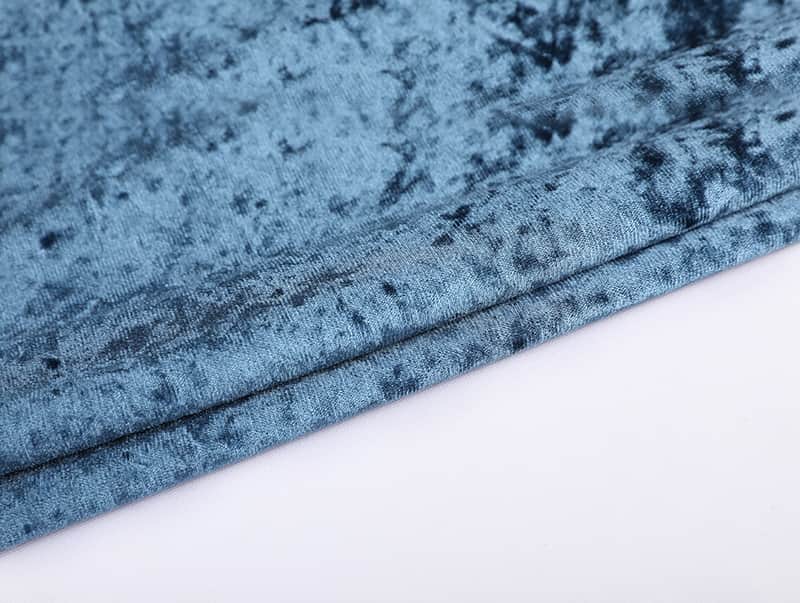
For ball gowns, formal jackets, and evening coats, velvet is the appropriate choice. The sheen and drape of viscose or silk velvet are integral to the formal aesthetic, and the dry-clean care requirement is acceptable for garments worn infrequently. Pile direction should run upward on most evening garments to produce the deepest, richest color tone. Crushed velvet, which is deliberately processed to create a crinkled pile, offers a more relaxed formal option with easier care than standard velvet.
Tailored Everyday Garments
For blazers, trousers, structured skirts, and childrenswear, velveteen is the practical choice. Its body and structure make it easier to tailor than velvet, its machine washability makes it realistic for regular wear, and its matte finish works well in casual and smart-casual contexts where the high sheen of velvet would be excessive. Cotton velveteen in navy, burgundy, or forest green is a classic choice for childrenswear and smart-casual adult garments during autumn and winter.
Activewear, Loungewear, and Stretch Garments
For tracksuit sets, leggings, hoodies, baby bodysuits, and any garment that needs to move with the body, velour is the only appropriate choice of the three fabrics. Its stretch allows full range of motion without seam stress, and cotton velour in particular is soft enough to wear against infant skin. Polyester velour is used extensively in athletic and leisure wear because it dries quickly and retains its pile through repeated machine washing.
Home Furnishings and Upholstery
For curtains, cushion covers, and decorative throws, velvet produces the most dramatic visual effect. For upholstery on frequently used furniture, velveteen offers better durability at lower cost. Velour is rarely used in home furnishing applications because its stretch and softer pile make it less suitable for structured upholstery, though cotton velour can work well for casual throws and baby blankets where softness is the primary criterion.
For high-traffic upholstery such as sofa seats and dining chair pads, it is worth noting that cotton velveteen rated at 30,000 Martindale cycles or above is the minimum specification recommended by upholstery professionals for residential seating. Standard dress-weight velvets are not suitable for seating upholstery as their pile density is designed for drape and appearance rather than abrasion resistance.
Care and Maintenance for Each Fabric Type
Incorrect care is the most common cause of pile crushing, color change, and texture degradation in all three pile fabrics. The following care guidance applies to typical versions of each fabric; always check the specific care label on your fabric or garment before proceeding.
| Care Step | Velvet | Velveteen | Velour |
|---|---|---|---|
| Washing | Dry clean recommended; cold hand wash for some polyester velvets | Machine wash cold, gentle cycle, inside out | Machine wash warm or cold, gentle cycle |
| Drying | Hang or lay flat; never tumble dry | Tumble dry low or air dry; remove promptly | Tumble dry low; remove before fully dry |
| Ironing | Steam only; never direct iron contact; use velvet board | Iron inside out on low heat; use press cloth | Steam only; avoid direct iron contact |
| Pile Restoration | Steam and brush gently in pile direction | Tumble dry with damp cloth; brush when warm | Tumble dry on low; shake and smooth by hand |
| Storage | Hang on padded hanger; never fold if possible | Fold loosely or hang; avoid compression | Fold or hang; pile is resilient to folding |
One universal rule across all three fabrics: never apply a hot iron directly to the pile surface. Direct heat flattens and fuses pile fibers, creating permanent shiny marks called shine marks or burn marks that cannot be reversed. All three fabrics should be steamed from above with the pile facing down onto a thick towel or needle board, which allows the pile to hang freely while the steam relaxes any crushing.
Sewing Tips Specific to Each Pile Fabric
Each of the three fabrics presents specific challenges during cutting and construction that differ from those encountered with non-pile woven or knit fabrics. Knowing these in advance prevents the most common sewing failures.
Cutting All Three Fabrics
- Cut velvet and velveteen with all pattern pieces oriented in the same direction, with the nap running upward for deepest color or downward for a smoother surface. Never fold velvet face to face for double-layer cutting; instead cut single layer to avoid crushing the pile at the fold.
- Use sharp scissors or a rotary cutter for all three fabrics. Blunt cutting tools compress the pile at the cut edge, making seam allowances harder to handle. Cut velvet from the wrong side where possible to avoid pressing the pile with your hand during cutting.
- For velour, account for its stretch when cutting. Pin the fabric to the cutting mat or use weights rather than pins that distort the stretch before cutting. Cut on the cross grain for maximum stretch in the width direction of finished garment panels.
Stitching Recommendations
- Use a walking foot (even feed foot) for sewing velvet and velveteen seams to prevent the upper layer from shifting relative to the lower layer due to pile surface friction. Without a walking foot, seams frequently distort by 3 to 10 mm over a 50 cm seam length, causing misaligned panels and puckered seams.
- For velour, use a stretch stitch such as a narrow zigzag (1.5 mm width, 2.5 mm length) or a triple stretch stitch for main seams. A ballpoint needle sized 80 to 90 prevents the needle from cutting knit loops and causing runs in the fabric structure.
- Sew velvet seams at a slightly longer stitch length than usual, around 3 mm, to reduce the chance of seam puckering. Finish seam allowances individually rather than pressing them together to avoid flattening the pile on the garment face.